
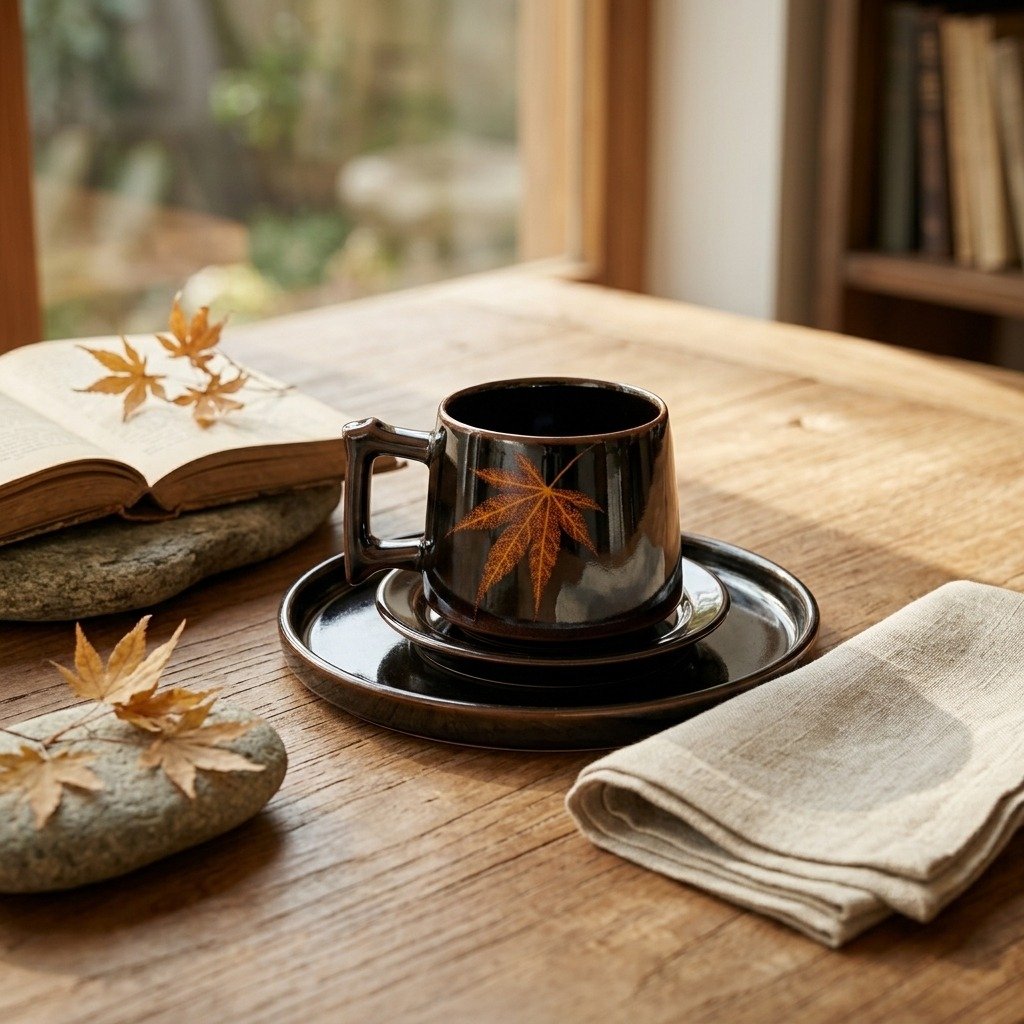
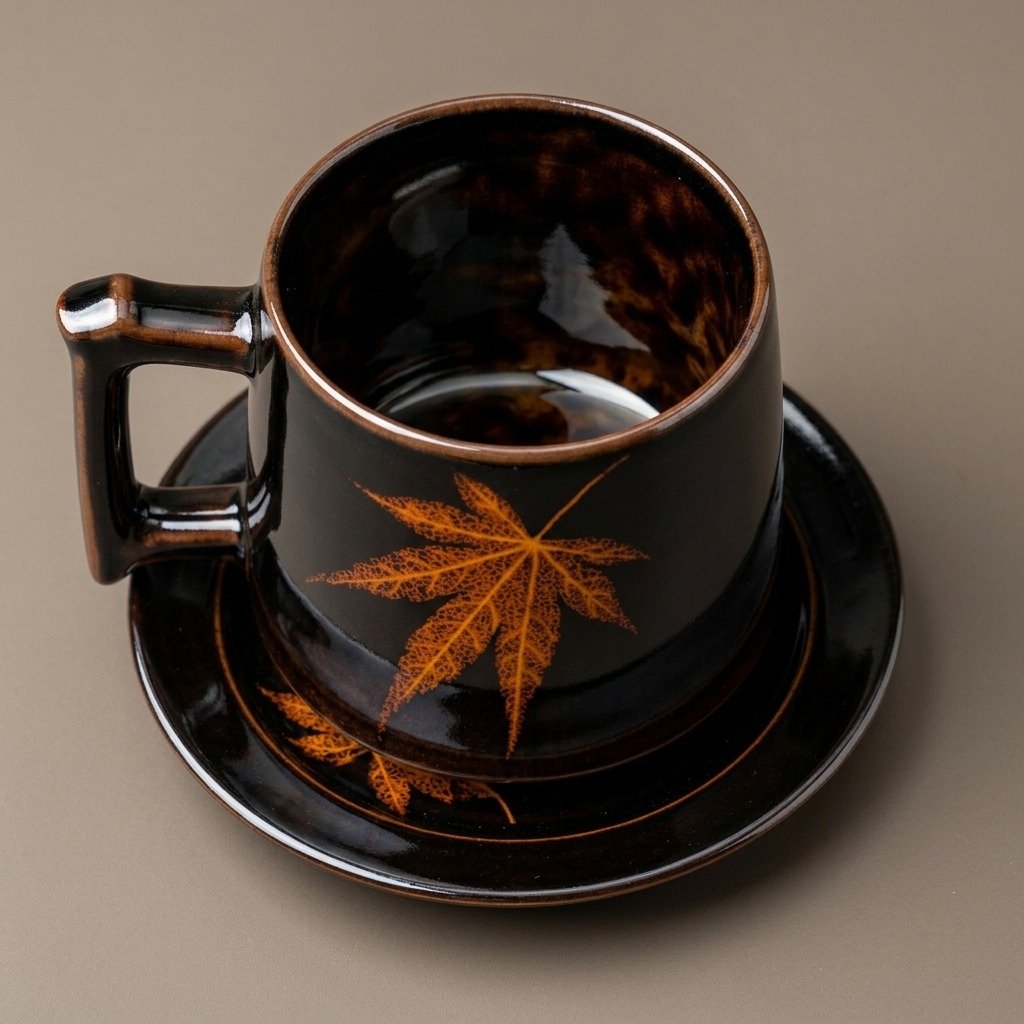
A pointed leaf spreads across the dark surface of Aurioo's Maple Leaf mug and saucer. Fine lines run from its centre towards the tips. On the smaller Maple Motif host cup, the leaf appears broader and more golden against the rounded black body.
Both listings name maple as the decorative subject. The useful place to begin is the leaf's outline: several pointed divisions spread from a shared centre, rather like the fingers of an open hand. That shape, its warm colour and the way it sits on the vessel can guide your choice without assigning the design one fixed meaning.
Read the leaf shape before its colour
NC State's profile of Japanese maple offers a botanical example of this hand-shaped form. It explains that palmatum refers to the leaf's shape and describes leaves with five to nine lobes. Colour varies with the cultivar and season, including green, yellow, bronze, purple and red.
That example helps explain the visual vocabulary of a maple motif. The pointed sections are lobes of one leaf, joined nearer the centre. On the mug, narrow divisions and visible vein-like lines make the silhouette easy to follow across the dark ground. On the host cup, a broader golden shape brings the leaf closer to the front of the rounded form.
A ceramic motif is a designed image, and these product names do not identify a maple species or cultivar. The Japanese maple profile is a useful comparison, not an identification of the plant represented on either piece. Likewise, golden ceramic colour cannot establish the colour of a particular living tree.

An autumn connection with a specific cultural example
Maple leaves can bring an autumn association to the tea table. A documented example appears in the Metropolitan Museum of Art's Maple Viewing at Kai'anji Temple, a nineteenth-century Japanese painting by Shibata Zeshin. The museum describes a temple site famous for autumn foliage, with tall red-leaved maples colouring the hill.
That is a specific example of Japanese maple viewing. It offers context for enjoying an autumn leaf design, without establishing the origin of Aurioo's ceramics or the maker's intended message. The current pieces are listed as Jizhou kiln teaware; the painting is a separate artwork from another setting.
On the mug and host cup, warm leaf colours stand out against a dark background. You might choose that combination for an autumn arrangement, or simply enjoy the contrast throughout the year.
Choose how the motif fits your drinking routine
The handled mug gives the leaf a taller exterior to occupy. Its matching saucer creates a separate resting place beneath the mug. The host cup has a rounded, handleless body, so the motif is seen across a smaller curved surface as you turn the cup.
| Detail | Mug and saucer | Host cup |
|---|---|---|
| Named decoration | Maple Leaf Motif | Maple Motif |
| Body and glaze | Black pottery with plant ash glaze | Black pottery with plant ash glaze |
| Listed capacity | 450 mL | 130 mL |
| Vessel dimensions | Mug: 10 cm diameter; 8 cm height | Cup: 8 cm diameter; 5.5 cm height |
| Included single unit | One mug and one saucer | One host cup |
| Saucer dimensions | 13.5 cm diameter; 2 cm height | No saucer listed |
| Visual placement | Pointed amber leaf across the taller body | Broader golden leaf on a rounded body |
Choose the handled mug for a daily drink or the host cup for short tea pours, using the listed capacities as a starting point. The mug listing includes its saucer. The host cup listing specifies one cup; a cup rest visible in a scene is not part of that stated unit.
Leave comfortable room below the rim in either vessel. Listed capacity is a specification, rather than a serving target. If you are choosing a personal cup for a shared session, our host cup guide explains that role. Here, the maple image is the feature to compare once you know which kind of drinking vessel you want.

Keep the named motif separate from the making method
Both listings describe black pottery with plant ash glaze and handmade, kiln-fired ceramic construction. Those are the available material and craft descriptions. The visible leaf is the named decoration, but its appearance alone does not establish that an actual leaf was pressed, transferred or fired into the surface.
Our teaware glaze guide explains the broader surface categories. When choosing these maple pieces, compare the full product views and the listed details rather than inferring a workshop process from the veins or edges of the design.
The outlines also differ from a fan-shaped leaf. If you are comparing leaf subjects across the collection, the ginkgo motif guide follows that different shape on another Jizhou cup. It is a way to choose the botanical image you prefer, without treating every leaf as interchangeable decoration.
After use, follow the listings' gentle rinsing and drying guidance. The decorated-teaware cleaning guide gives a fuller routine. Keep the mug and saucer separate while drying, then bring them back together for the next cup.
Frequently asked questions
Does the maple design identify a particular tree species?
The listings name Maple Leaf or Maple Motif, but do not specify a species or cultivar. Japanese maple supplies one useful botanical comparison for the hand-shaped outline; it should not be treated as a confirmed identification of the ceramic design.
Are real maple leaves fired into these pieces?
The listings describe black pottery, plant ash glaze and handmade, kiln-fired construction. They do not confirm an actual-leaf transfer or imprint process for these two items. The image alone is not enough to establish that technique.
Does the Maple host cup include a saucer?
Its listed unit is one host cup. The Maple Leaf mug is a different listing that includes one mug and one saucer. Check the selected quantity option and arrange any additional serving pieces separately.