

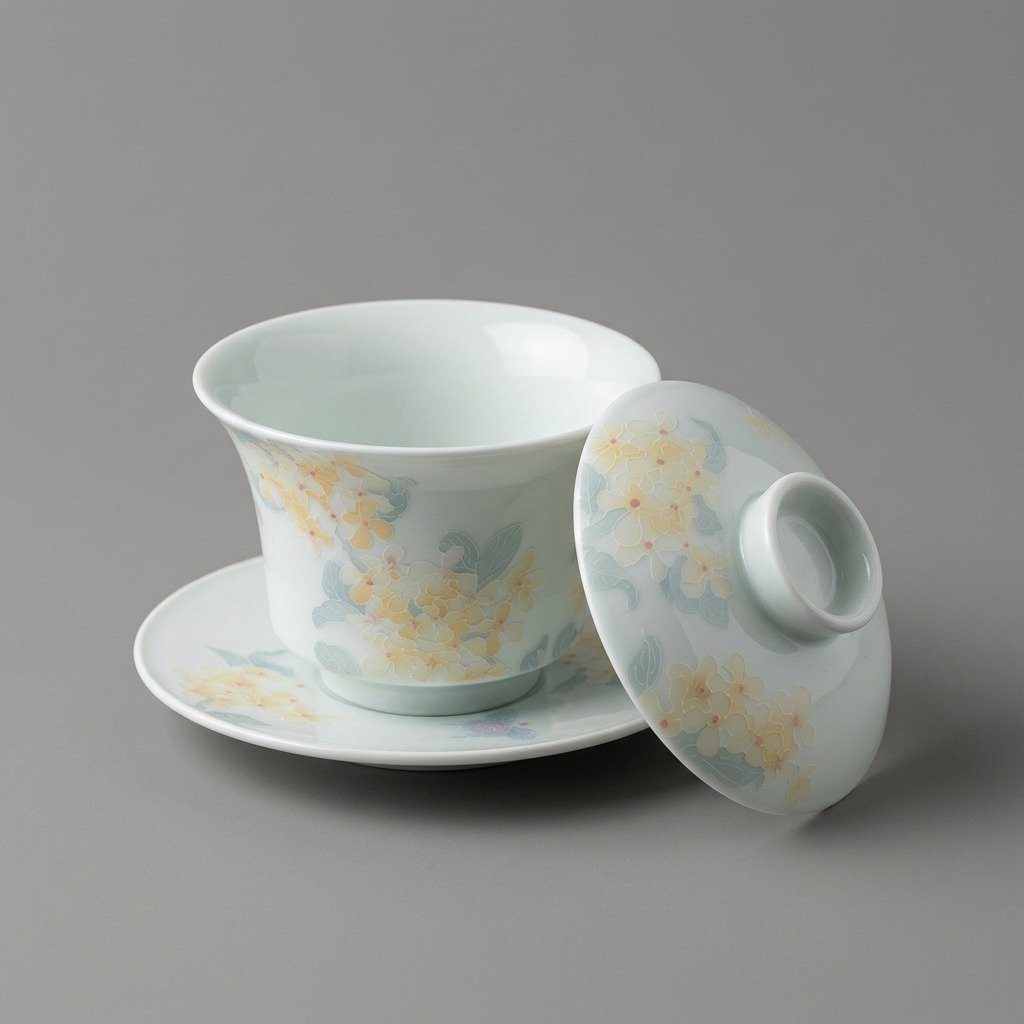
The small yellow blossoms on Aurioo's Osmanthus Floral Relief gaiwan spread across the bowl, lid and saucer. From a distance, the pattern looks soft and light. Close up, its raised outlines give the flowers a different presence from a flat painted sprig.
In Chinese culture, osmanthus is associated with autumn and scholarly achievement. Those references can help you choose a pattern that feels personal, while the gaiwan's size, components and handling determine how it fits your tea table.
The plant behind the small blossoms
Osmanthus is known in Chinese as guihua, 桂花. NC State's profile of Osmanthus fragrans describes a broadleaf evergreen shrub with small, strongly fragrant flowers and leathery leaves. White and orange-flowered varieties exist. The flowers grow close to the leaves, rather than forming the large, solitary bloom familiar from a magnolia design.
On this gaiwan, look for groups of small yellow flowers among muted green leaves. The decoration follows the rounded surface instead of placing a single large flower in the middle of a panel. Its pale background leaves room between the branches, so you can see how the pattern continues as you turn the bowl.
The product is named for its osmanthus motif. Its ceramic colours are an artistic treatment; they do not identify a particular living cultivar. You can enjoy the connection to the plant without treating the painted branches as a botanical specimen.

Why osmanthus suggests autumn and achievement
Lan Su Chinese Garden's account of osmanthus connects the flower's fragrance with autumn and recounts the legend of Wu Gang chopping an endlessly healing osmanthus tree on the moon. That story helps explain the flower's place in lunar and Mid-Autumn imagery.
The garden also explains zhe gui, 折桂, literally plucking osmanthus, as a metaphor for success in the imperial examinations and, more broadly, scholarly achievement. A gaiwan with this motif can therefore suit someone who enjoys autumn imagery or wants a quiet reminder of study and progress. This is cultural context for choosing the design, rather than a claim about the maker's intended message.
You do not need a seasonal occasion to use it. The small blossoms and pale ground can be a daily preference in their own right. If you choose it as a graduation gift, a short note about the scholarly association makes the thought easier for the recipient to understand.
Follow the relief across the whole gaiwan
The listing describes hand-outlined relief glaze, hand-filled colour and gas-kiln firing on a jade clay ceramic body. Our guide to Heni floral relief teaware explains that surface treatment in more detail. Here, the useful thing to notice is how the raised floral work catches light across three differently shaped surfaces.
The bowl gives the branches the largest curved area. On the lid, the design is seen from above; on the saucer, the flowers sit around the resting place for the bowl. Set the pieces beside one another before a session to see the pattern clearly. Each hand-finished piece can vary in placement and glaze tone, so an exact match between every photographed flower and a delivered piece should not be expected.

What the dimensions and included pieces mean
The listed 180 mL capacity describes the vessel, rather than a guaranteed serving of finished tea. Leaves and comfortable headroom take up space. Our tea-cup capacity guide explains why nominal vessel size and the amount you actually pour need to be considered separately.
| Detail | Current listing | What to consider |
|---|---|---|
| Gaiwan size | 180 mL; 8.5 cm diameter; 7.5 cm height | Allow space for leaves and headroom; poured yield varies. |
| Saucer size | 11 cm diameter; 1.5 cm height | Leave room for its footprint at your brewing place. |
| Included unit | Gaiwan with lid and one saucer | Drinking cups and scene accessories are separate. |
| Surface | Hand-outlined relief glaze with hand-filled colour | Look at raised outlines and how light falls across them. |
| Motif | Osmanthus flowers | Autumn and scholarly associations are cultural context. |
The current listing includes a gaiwan and saucer, with the lid shown as part of the gaiwan. The One and Value pack(2) choices refer to quantity. Check the selected option when ordering, especially if you want more than one complete unit. A drinking cup, pitcher and tea tools visible in a scene are separate from the stated contents.
The saucer gives the bowl a defined resting place, but it does not establish that every brewing grip will feel comfortable. Our gaiwan and saucer option guide shows why included pieces deserve a separate check from capacity and decoration.
Bring the floral design into a real session
Place the gaiwan on a stable, heat-resistant surface and practise the lid gap and pour with cool water before brewing. Choose leaf quantity, water temperature and timing for the tea you have. The first gongfu session guide covers that sequence if you are new to a lidded brewing bowl.
After tea, empty the leaves, rinse the bowl, lid and saucer gently, and let them dry before storage. Avoid rubbing the raised decoration with abrasive tools. For a fuller routine, see cleaning hand-painted teaware.
The appeal of this gaiwan is easy to revisit: small blossoms spread over a vessel you turn, open and use. Osmanthus adds an autumn and scholarly connection to that everyday object, while the relief gives you something visible to notice each time the light changes.
Frequently asked questions
What does osmanthus mean in Chinese culture?
It is associated with autumn, lunar stories and scholarly achievement. The expression zhe gui links the flower with examination success. Those associations offer context for the motif; their relevance depends on the occasion and the person choosing it.
Does this gaiwan add osmanthus fragrance to tea?
The flowers are ceramic decoration. The product listing does not describe a scented surface or a flavouring function. Brew the tea you choose; an osmanthus design does not turn it into osmanthus tea.
What comes with the Osmanthus Floral Relief gaiwan?
The listing specifies a gaiwan and an 11 cm saucer; the pictured gaiwan has a bowl and lid. Its listed capacity is 180 mL. Check whether you selected One or Value pack(2), and choose any drinking cups or serving pieces separately.