

Blue bamboo leaves and a blue mountain scene can give two white porcelain pieces very different appearances. Aurioo’s Sword Kiln Blue Bamboo cup has overlapping stems and pointed leaves around a wide bowl. The Blue Landscape Pear teapot carries a more spread-out scene across a rounded body and lid.
When choosing blue and white porcelain teaware, look at how the painting occupies the vessel. A close photograph helps you follow a brushstroke; a whole-piece view shows how much white porcelain surrounds it. Both views matter when deciding what you would enjoy seeing on your tea table.
What blue-and-white describes
The V&A’s introduction to Chinese blue-and-white ceramics explains the historical combination of cobalt-blue decoration and a white ceramic body, usually painted beneath a glaze. It also shows how outlines, differences in blue tone and areas left white create different effects within that limited palette.
For a contemporary piece, check its own craft description. The Sword Kiln Blue Bamboo cup explicitly lists hand-painted underglaze blue bamboo on jade clay porcelain. The pear teapot is described as hand-painted blue-and-white porcelain. Its listing does not identify every pigment or processing step. Aurioo’s guide to underglaze and overglaze decoration explains the separate question of where a painted design sits in relation to the glaze.
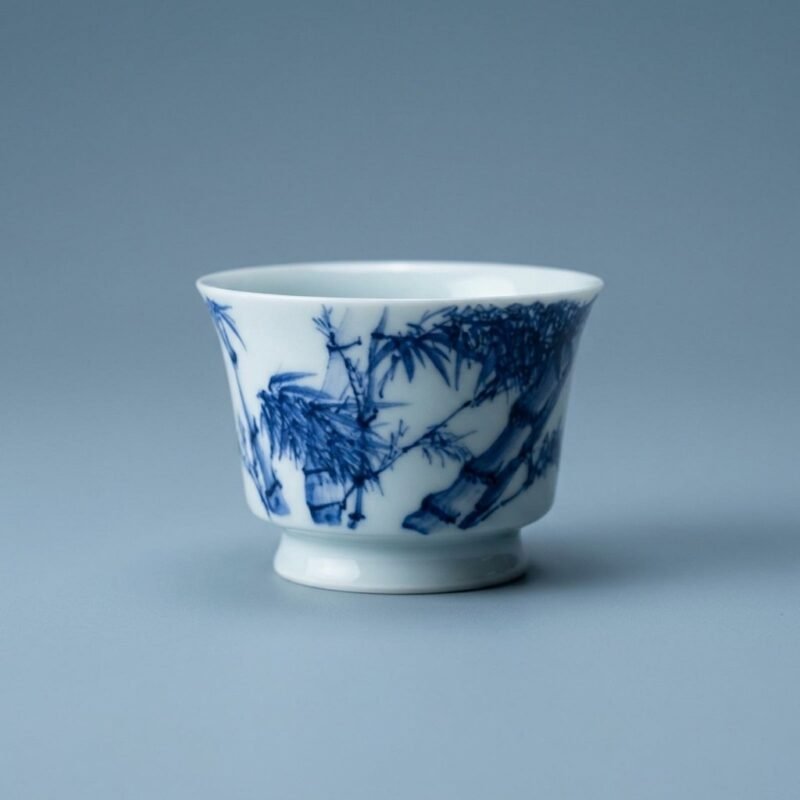
Follow the bamboo across the cup
Start with a stem, then follow the leaves branching from it. Some strokes are narrow and separate; others overlap into darker groups. The white areas between them let you distinguish one branch from the next. Look at those gaps as well as the blue marks.
The cup’s flared rim and small foot frame the painting. In a front view, the stems and leaves occupy much of the exterior, while the pale interior remains visible above them. That gives you a useful choice: do you prefer a fuller pattern close to your hand, or a vessel with more uninterrupted white space?
This cup is listed at 130 mL, with a 9 cm diameter and a 5 cm height. Those measurements describe the drinking vessel. They do not tell you whether its particular arrangement of bamboo will appeal to you, so compare the dimensions and photographs together.
Look for changes in blue on the pear teapot
The Blue Landscape Pear teapot gives the painter a different surface. Its body narrows toward the lid, with a handle on one side and a spout on the other. Small landscape details sit beside broader, paler blue areas.
Compare the darker marks near the lower body with the lighter areas above them. Then step back to the whole form. You may notice the outline of the pot first, or your eye may settle on a dark patch within the landscape. That is a matter of composition and personal preference; the darkest decoration is not a quality grade.
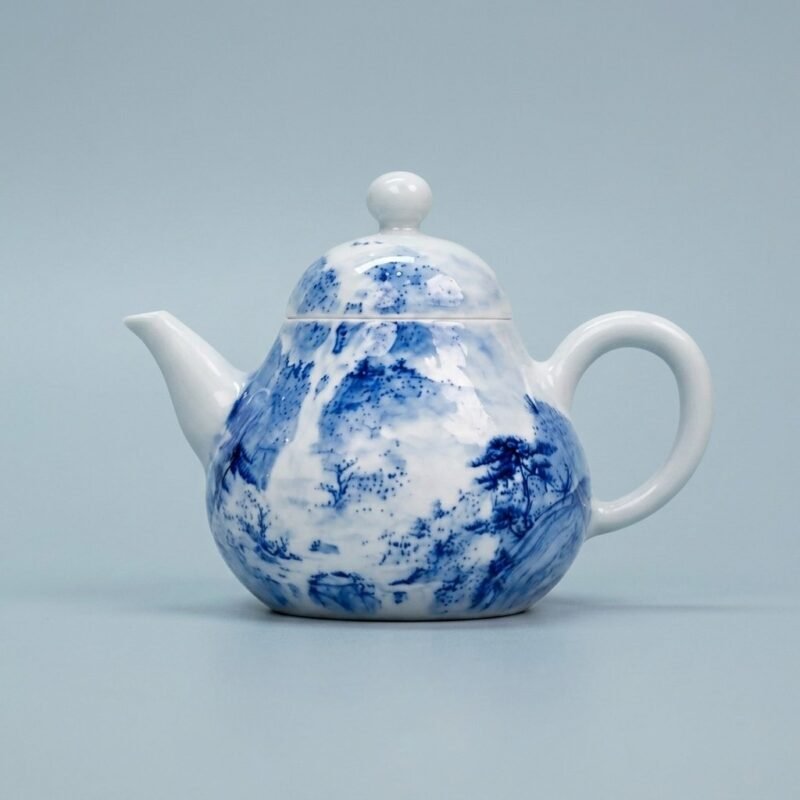
Our article on Chinese landscape imagery on a tea cup looks at the subject of a painted scene. Here, the question is how blue marks and white space work together on the object you are choosing.
A short checklist for comparing the decoration
| Look at | What to compare on these pieces | Keep this separate |
|---|---|---|
| Line | Individual bamboo leaves on the cup; small landscape marks on the pot | A fine line alone does not establish the maker or age. |
| Blue tone | Dark overlapping strokes beside paler painted areas | Darker blue does not automatically mean better porcelain. |
| White space | Gaps between branches; clear areas around the teapot’s scene | A less densely painted vessel is a different visual choice, not an incomplete design. |
| Whole form | The cup’s open rim and foot; the pot’s body, handle, spout and lid | Decoration does not establish pouring comfort or a usable fill level. |

Choose the piece you need at the table
The bamboo cup holds brewed tea for drinking. The pear teapot, listed at 160 mL, steeps the leaves. Its single option includes one teapot; the cup’s single option includes one cup. Buying the two gives you those two pieces, with any pitcher or additional guest cups chosen separately. The Chinese tea set guide explains the other serving roles.
Leave space below the rim rather than treating listed capacity as a serving target. Tea leaves occupy room in the pot and retain some water. Follow the tea’s brewing directions, and practise handling an unfamiliar pot with cool water first.
Both listings describe handmade variation in brush placement and glaze tone. Follow their gentle rinsing and drying instructions; dry the pear teapot’s body and lid separately. A blue-and-white label does not establish dishwasher or microwave suitability.
Frequently asked questions
Is blue-and-white a material?
It describes a decorative appearance and tradition. Read the material separately: both Sword Kiln pieces discussed here are listed as jade clay porcelain. Porcelain is a type of ceramic.
Does a darker blue area prove a higher-quality cup?
No. Compare the pattern, finish, dimensions and stated craft details. Blue intensity by itself does not establish quality, age or provenance.
Do the bamboo cup and pear teapot make a complete tea set?
Their single options supply one cup and one teapot. Choose any additional drinking cups or serving pitcher for the way you plan to serve tea.