

“Hand-thrown” tells you how a vessel was formed, while a name such as Carved Texture or Spiral Relief draws attention to its surface. Reading those details separately makes it easier to compare two Er Kang tea mugs without assuming that every visible line came from the potter's wheel.
Aurioo's Carved Texture mug and Spiral Relief mug are both listed as hand-thrown and high-temperature kiln fired. They have different profiles and exterior patterns, yet their stated capacities are both about 150 mL. The forming term helps explain what they share; the product views help you decide which finished object you prefer.
What wheel throwing means
The Museum of Oriental Ceramics, Osaka's technique guide describes wheel throwing as shaping clay through rotation and pressure from the hands. It distinguishes that work from trimming a surface on the wheel. Both operations can involve a rotating vessel, but they do different jobs.
For a shopper, that distinction is useful. The hand-thrown description concerns forming the vessel. It does not specify every later step, the tool used for a decorative line or the treatment of the handle. The Er Kang listings confirm the forming and firing terms but do not supply a complete workshop record for either mug.
Look first at the silhouette: where the wall curves, how the rim opens and where the body meets its base. Then look at the surface. This gives you two concrete questions to ask of the photographs instead of treating handmade as one broad visual style.
A formed body can receive further surface work
In Kirsty Kash's carved-and-inlaid pottery article, the practitioner begins with a thrown form, plans a pattern around it and carries out carving before later colour and glaze work. Her example makes the separation clear: forming creates a body that can then receive further treatment.
That is a case study of Kash's own practice. Her clay, tools, inlay and firing choices do not establish how an Er Kang pattern was made. For these mugs, use the verified listing terms and the visible design; a similar-looking mark is not enough to identify an identical technique.
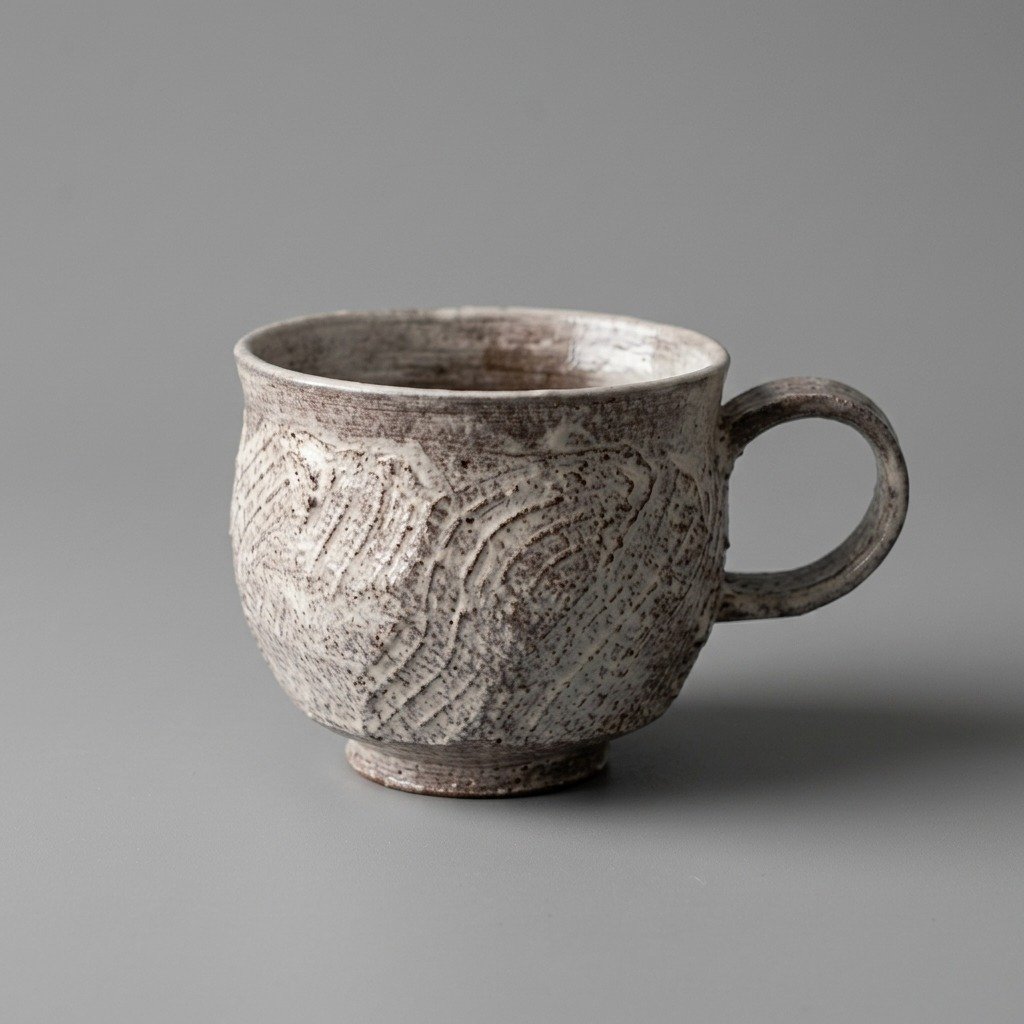
The Carved Texture mug has a rounded body, a short visible foot and an exterior crossed by irregular curved marks. Its darker, mottled surface differs from the pale Spiral Relief mug, where groups of close-set curved lines alternate with more open areas. Follow those patterns around the photographed body, rather than judging the whole piece from one small patch.

Compare the mugs as finished drinking vessels
The Carved Texture mug is listed in old rock clay ceramic, while the Spiral Relief mug is listed in fine ceramic. Those are the catalogue's material descriptions. Neither name supplies a measured heat-retention result, and the hand-thrown description does not by itself rank one above the other for daily use.
| Listing detail | Carved Texture mug | Spiral Relief mug |
|---|---|---|
| Material | Old rock clay ceramic | Fine ceramic |
| Forming and firing | Hand-thrown; high-temperature kiln fired | Hand-thrown; high-temperature kiln fired |
| Capacity | 150 mL | Approximately 150 mL |
| Listed diameter and height | 8 cm diameter; 6 cm height | 8 cm diameter; 6.5 cm height |
| Visible exterior | Rounded, darker mottled body with curved marks | Paler body with groups of close-set curved lines |
| Single unit | One handled mug | One handled mug |
The same nominal capacity does not mean the same outline. The Spiral Relief mug is listed half a centimetre taller, while both have an 8 cm listed diameter. Its pale exterior and repeated line groups give it a different visual rhythm from the darker rounded Carved Texture mug. Choose between those features alongside the amount of tea you want to pour.
The rim, interior and handle matter to the finished object too. A top view helps you see the opening and inside surface; a side view makes the handle's position clearer. Photographs cannot tell you exactly how a handle will fit your hand. The listed diameter should not be treated as a complete measurement of the space needed around the handle.

Keep forming, decoration and use as separate questions
A useful way to read a listing is to ask what it says about the body, what it says about the surface and what it includes. Here, each unit contains one handled mug. The One and Value pack(2) choices refer to quantity; a lid, infuser, saucer or tea-table accessory is not listed as part of a single mug.
Our guide to teaware glaze explains the surface category in more detail. Glaze and firing information answer different questions from the forming term. A photograph of a textured surface does not replace product-specific information about intended use or care.
The two mugs are made for drinking prepared tea or another suitable warm drink. Start with a comfortable portion below the rim and follow the tea's preparation instructions separately. For a broader comparison of handled and handleless drinking vessels, see teacup versus mug. After use, wash gently and dry fully; the decorated-teaware cleaning guide covers that routine.
The same forming term appears in our Er Kang teapot shape guide, which compares three brewing vessels. Use hand-thrown to understand the forming method, then compare the mugs' surfaces, dimensions and care instructions.
Frequently asked questions
Does hand-thrown mean every mark came from the wheel?
No. It describes forming on a potter's wheel. Trimming and surface treatment are separate operations. These listings do not document the exact tools or sequence used for each decorative mark.
Are the Carved Texture and Spiral Relief mugs the same size?
Both are listed at about 150 mL and 8 cm in diameter. The Carved Texture mug is listed at 6 cm high; the Spiral Relief mug is 6.5 cm high. Their profiles and exterior patterns also differ.
Can a photograph prove how a mug was made?
A photograph shows its finished appearance. Use the maker or seller's specific process description to establish the stated forming method, and ask for further details if a particular technique matters to your purchase.