
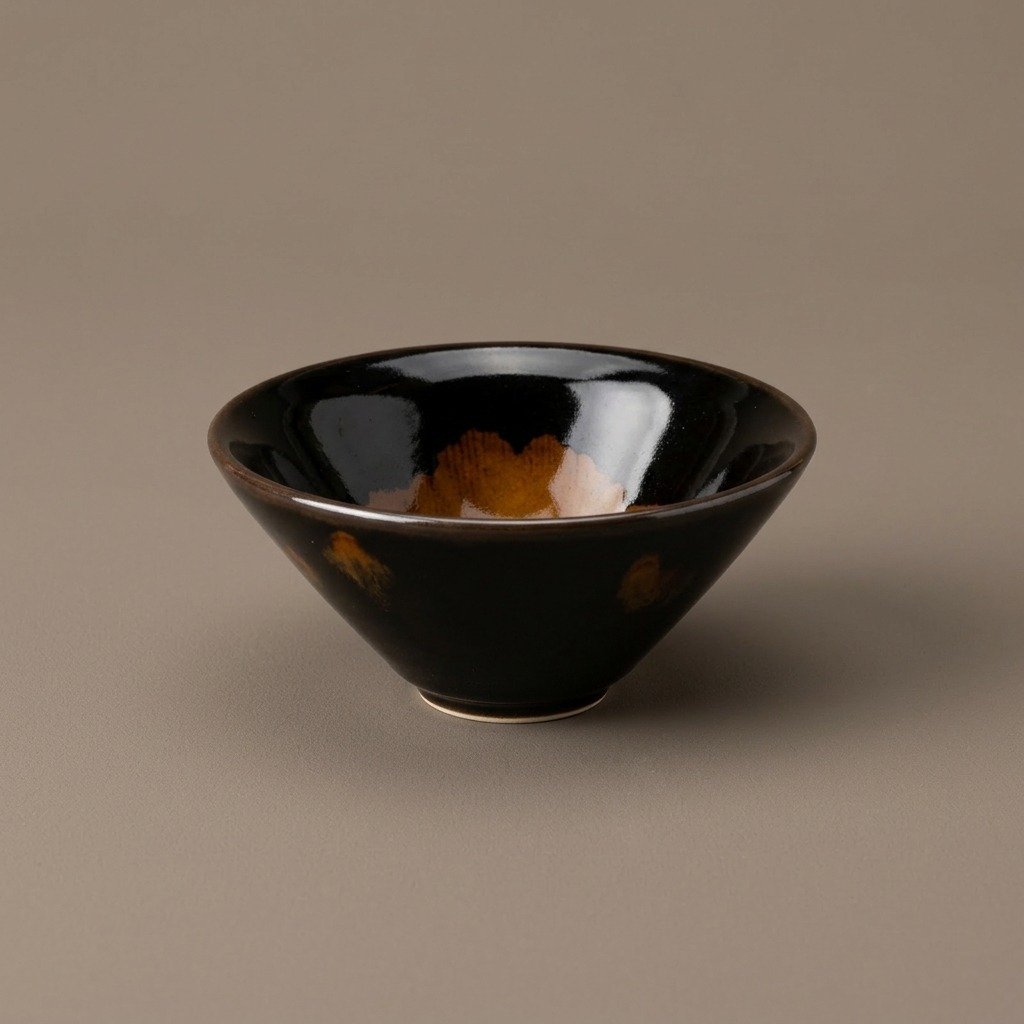
An amber mark on a dark tea cup catches the eye. It does not give you the full name of the ware. If you are comparing Jian Zhan, Tenmoku and Jizhou listings, start with what each name identifies, then check the description of the piece you intend to buy.
Aurioo’s Ginkgo Douli cup, Leopard cup pair and Maple Motif host cup are listed as Jizhou pieces. Their dark bodies and contrasting decoration make them useful examples of why a photograph and a product name answer different questions. You can enjoy the finish while still reading the label carefully.
The names are related, but their scope differs
Jian ware is associated with Fujian. The Montreal Museum of Fine Arts identifies its Jian tea bowl as a Fujian example. Jizhou is a different ceramic tradition: the Metropolitan Museum of Art identifies its Jizhou bowl with production in Jiangxi.
Tenmoku has a wider historical use. Kyoto National Museum’s guide to Tenmoku teabowls discusses Jian, Jizhou and other Chinese examples, as well as Japanese production. The word therefore cannot, by itself, establish that a particular cup is Jian ware.
These museum examples explain the terminology. They do not authenticate a modern cup or establish who made a particular retail piece. For an Aurioo purchase, read the actual product description and ask about any detail you need clarified.

Read “Jizhou” alongside the particular product
The Ginkgo Douli Jizhou cup is listed as black pottery with plant ash glaze. Its description identifies a ginkgo motif, one tea cup, and a capacity of 100 ml. The listed diameter is 8 cm and height 5.5 cm.
That is a more useful description of this purchase than simply calling it a dark cup. It tells you which product family Aurioo lists, which decoration to expect and what one selected unit contains. The gallery helps you examine the open bowl and the placement of the motif; the written listing supplies the material and quantity information.
Handmade glaze and pattern placement may vary. A difference between two photographs is not a reason to assign a different kiln name, and a close visual resemblance to a museum bowl does not establish shared provenance.
A pair and a host cup are different order choices
The Leopard Jizhou cup pair is explicitly sold as two cups per set, with a listed capacity of 60 ml each. Its gallery shows amber patterning across a dark surface. Read “pair” as a quantity description, rather than treating it as another ceramic classification.
The Maple Motif Jizhou host cup is listed as one host cup, at 130 ml. “Host cup” describes its intended drinking role in the catalog. It does not turn the piece into a fairness pitcher, nor does it change the Jizhou identification in the product name.

| Current Aurioo listing | Listed material or family | Contents for the single set/unit | Listed capacity |
|---|---|---|---|
| Ginkgo Douli tea cup | Jizhou; black pottery with plant ash glaze | One tea cup | 100 ml |
| Leopard tea cup pair | Jizhou; black pottery with plant ash | Two tea cups per set | 60 ml each |
| Maple Motif host cup | Jizhou; black pottery with plant ash glaze | One host cup | 130 ml |
The Ginkgo and Maple listings offer One and Value pack(2) options. Confirm the option shown in your order. The Leopard product is already a two-cup set. Capacities are catalog figures; allow headroom when serving.
Separate the product name from what the image can show
A gallery can show the cup’s outline, interior and visible decoration. Use those views to decide whether you like the piece and to understand its form. The image cannot establish a firing temperature, chemical composition, workshop attribution or food-safety result.
Likewise, a label such as “Tenmoku-style” elsewhere is not a complete material specification. Check the seller’s full description rather than treating a shared glaze color as proof that two cups belong to the same tradition.
The Teasenz guide to Tenmoku and Jian Zhan cups introduces the terminology that buyers encounter. The distinction relevant to this Aurioo selection is straightforward: these three products are listed as Jizhou. Their names and descriptions do not identify them as Jian Zhan.

Keep the comparison focused on your purchase
Before choosing among the three, decide whether you want one cup or a pair, then read the dimensions and inspect an open view. If a specific origin, workshop or glaze specification is essential to your purchase, ask for information about that exact product. A general article about a ceramic tradition cannot supply missing details for an individual item.
For broader background on Aurioo’s existing Jizhou coverage, the tortoiseshell porcelain article discusses the decorative tradition. The practical task here is narrower: know what the name on the listing says, and keep it separate from a conclusion drawn from appearance alone.
FAQ
Is every Tenmoku cup a Jian Zhan cup?
No. Kyoto National Museum uses Tenmoku in discussing examples from several ceramic traditions, including Jian and Jizhou. Read the more specific attribution and product description before treating the names as interchangeable.
Are these Aurioo cups listed as Jian Zhan?
No. The Ginkgo Douli cup, Leopard cup pair and Maple Motif host cup named here are listed as Jizhou products. This guide follows those current descriptions and does not make an independent authentication claim.
Can a photograph prove a cup’s origin or safety?
No. Photographs help you inspect visible form and decoration. They cannot establish provenance or a safety test result. Ask about the particular specification you need, and follow the piece’s care instructions rather than attempting a home chemical or authenticity test.