

The pink flowers on Aurioo's Tulip Floral Relief gaiwan sit among pale green leaves around the bowl. Seen from the side, the flower shapes suggest small cups opening above their stems. Their outlines give you a useful starting point for looking at the decoration: follow one bloom, then the leaves around it.
Tulip flower shape is more varied than the familiar closed cup suggests. Understanding that variety helps you read a simplified ceramic motif without expecting a botanical illustration. On this gaiwan, the named flower is part of a hand-outlined relief design that continues onto the lid and saucer.
Begin with a single flower outline
NC State's Tulipa profile describes flowers that are usually solitary and upright, with cup, bowl or star forms depending on the species or cultivar. It records six tepals in two rings and broad, straplike leaves. Tepals are the petal-like parts of the flower.
That is botanical vocabulary for a living plant. In the gaiwan's motif, look first for the overall bloom: a pink, rounded outline with an open upper edge. Then follow the surrounding green forms. The design uses recognisable shapes at the scale of a small vessel; every anatomical part does not have to remain separately visible.
The flower and the leaf also do different visual work. The bloom gathers colour into a compact shape, while the leaves extend the design along the lower body. Looking at them separately makes it easier to see how the pattern wraps around the bowl rather than treating the whole surface as an indistinct floral band.

Use the plant as a reference, not a counting test
A stylised flower can preserve a cupped outline while simplifying overlapping parts. An angled bloom may show one side more clearly than the other. The relief and colour fill add another layer of simplification: small boundaries have to read across a curved, glazed surface.
The practical question is which details the design keeps visible. On this gaiwan, pale pink flower shapes and green leaves stand apart against a light ground. Their placement changes as you turn the piece. Compare the side view with the open-bowl view, where you can look at the lid and saucer separately.
The listing names the motif Tulip Floral Relief. It does not identify a botanical cultivar. Choosing this design can be a preference for that flower outline and palette, without assigning a cultivar from the ceramic colour or insisting on six separately drawn parts in each bloom.
| Detail | Botanical reference | Useful observation on the gaiwan |
|---|---|---|
| Bloom outline | Cup, bowl or star forms can occur. | Follow the pink edge and open upper outline in the side view. |
| Flower parts | Six tepals form the living flower. | Stylised and overlapping shapes need not show six separate parts. |
| Leaves | Broad, straplike leaves. | Trace the green forms around the lower bowl. |
| The whole subject | Flower and leaf are distinct plant parts. | Compare their outlines before reading the repeated floral band. |
Follow the motif over the three surfaces
The bowl offers the largest curved area for the flowers and leaves. The lid brings the design onto a surface usually seen from above, while the saucer carries decoration around the bowl's resting place. Opening the gaiwan lets you compare those areas without the lid covering part of the arrangement.
The product lists hand-outlined relief glaze with hand-filled pigment on a jade clay ceramic body. Our Heni floral relief guide explains that craft description. Here, the flower shapes are the subject: notice which outlines remain distinct and how the colour sits within them.
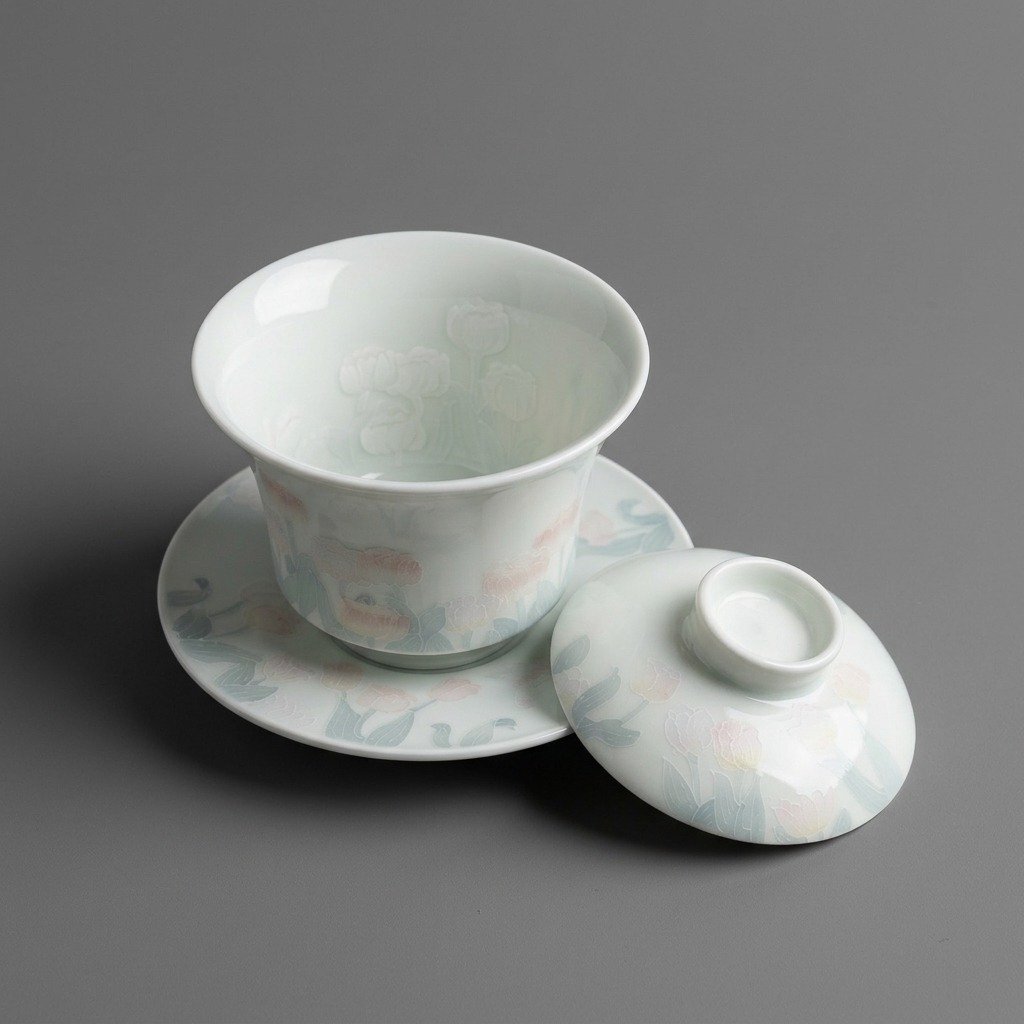
The hand-scale view lets you see the bowl, lid and saucer as a complete unit. The botanical motif can be considered alongside those proportions when choosing the piece.
Check the actual unit after choosing the flower
The current listing specifies a 180 mL gaiwan, 8.5 cm in diameter and 7.5 cm high, with an 11 cm saucer that is 1.5 cm high. The gaiwan includes its bowl and lid. Choose the One or Value pack(2) quantity option that fits your order; drinking cups and scene accessories are separate from the stated unit.
Our gaiwan and saucer option guide explains why included pieces deserve their own check. Nominal capacity is also separate from the amount of tea you will pour: leaves and comfortable headroom take up space inside the bowl.

For brewing, follow the tea's own preparation instructions and practise an unfamiliar lid gap and grip with cool water first. The first gaiwan session guide covers that sequence. After use, rinse gently and dry the pieces separately; our decorated-teaware cleaning guide gives the fuller routine.
If you prefer much smaller blossom shapes, the Osmanthus motif guide follows another flower on Heni teaware. It offers a different subject to compare with the larger individual blooms of this Tulip design.
Frequently asked questions
Are all tulip flowers cup-shaped?
No. The botanical reference describes cup, bowl and star forms, with variation between species and cultivars. The cupped outline is one useful way to recognise the named motif, rather than a rule for every tulip.
Must six tepals be visible in the ceramic pattern?
Six tepals describe the living flower. A stylised or angled motif can simplify or overlap those parts. The visible number of painted divisions is not a reliable way to identify a cultivar.
What pieces come with the Tulip Floral Relief gaiwan?
The listing includes the gaiwan and one saucer; the gaiwan has a bowl and lid. Its stated capacity is 180 mL. Check the selected quantity option and arrange drinking cups or other serving pieces separately.