
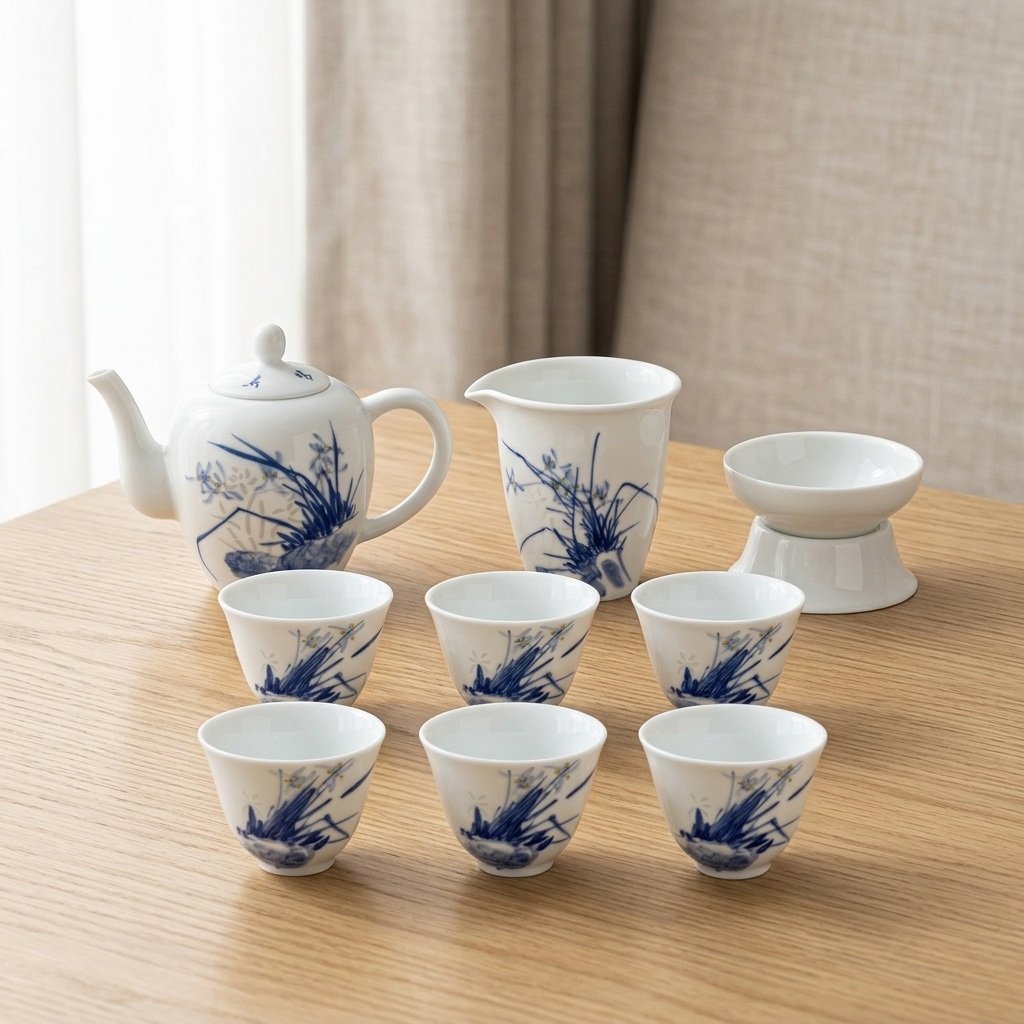
On Aurioo’s Orchid Porcelain Teapot Set, long blue leaves rise beside a painted rock on a tall white pot. The small blossoms take a moment to find among the leaves. That arrangement gives the orchid a different presence from a large flower filling the center of a vessel.
Orchid meaning depends on the tradition you are looking at. Modern flower gifts and Chinese scholar painting offer different associations. Knowing that distinction helps you look at this teapot without assigning every orchid design the same message.

An orchid in a bouquet and an orchid in a painting
Teleflora’s orchid symbolism guide associates the flower with love, luxury, beauty and strength. That is one useful context when someone chooses an orchid as a present.
Chinese painting gives the subject another history. The Smithsonian’s exhibition on orchids in Chinese painting explains how the cymbidium orchid became associated with integrity, loyalty and friendship, and how scholar painters used flowing ink strokes for its leaves and blossoms.
The connection between orchids and rocks is also documented in East Asian art. The Metropolitan Museum’s account of Shimomura Kanzan’s Spring Orchids, a Japanese painting, describes the pairing as a long-established subject associated with a scholar’s loyalty and integrity. These sources explain a visual tradition. They do not establish the precise intention behind the inscription or every brushstroke on a modern tea set.
Look at the leaves before the flowers
The orchid motif on the Aurioo pot is easiest to read by following the long, narrow leaves. They bend across the lower part of the body, with small blossoms above and beside them. The darker rock anchors the cluster close to the base.
Look at the spaces between the leaves. Open white areas let the separate blue strokes remain visible. The painting sits low enough to leave much of the pot’s shoulder white, while small blue details appear on the fitted lid. The upward-curving spout and tall body give the composition more height than a low, rounded pot would.

The product listing identifies hand-painted orchids, rocks and Chinese calligraphy. It does not provide a full transcription of the inscription, so there is no reliable basis here for translating it into a particular poem or promise. Aurioo’s guide to viewing a hand-painted teapot from different sides offers a practical way to examine decoration that continues around a curved body.
What the visible details can tell you
| Detail | Where to look on the Orchid set | A useful reading |
|---|---|---|
| Long leaves and small blossoms | The front of the teapot, with smaller motifs on the serving pieces | Follow the individual strokes to recognise the orchid subject. |
| Orchid beside a rock | The lower painted area of the teapot | The pairing has a documented history in East Asian scholar painting. |
| Blue painting on white porcelain | The pot, pitcher and cup exteriors | Blue is the decorative palette here; it does not identify the living flower’s color. |
| Chinese calligraphy | The inscription beside the painting | Treat it as a separate element to examine, without guessing at a translation. |

Give the design room during a tea session
The set includes a teapot with its fitted lid, a fairness pitcher and six cups, plus a complimentary ceramic strainer and its stand. Arrange the pieces so the pitcher is easy to reach and the spout has a clear pouring path. Set out the number of cups you need for that session.
The listed capacities are 300 mL for the teapot, 180 mL for the pitcher and 50 mL for each cup. The smaller pitcher cannot take 300 mL at once. Plan a brew that you can decant with headroom, or pour in stages. Listed vessel capacity is different from the amount of tea that reaches the cups after the leaves occupy space and retain water.
If you are new to these serving pieces, read how a fairness pitcher fits into tea service and how the included strainer differs from a tea infuser. Follow the tea’s brewing directions, then wash the set gently by hand and dry it before storage, as the listing recommends.
Frequently asked questions
Does orchid decoration have one fixed meaning?
No. Modern florist language and Chinese scholar painting give the flower different associations. An individual design and its inscription can add context; avoid treating any one meaning as universal.
Does a blue-painted orchid mean the flower itself is blue?
No. The Aurioo set uses blue painting for the leaves, flowers and rocks. The color belongs to the porcelain decoration and does not identify a botanical variety.
What comes with the Orchid Porcelain Teapot Set?
Aurioo lists one teapot with a fitted lid, one fairness pitcher, six tea cups, and a complimentary ceramic tea strainer with its stand. Small differences in hand-painted linework, color depth and placement are expected.