

A pair of tea cups can hold two different teas for one person to compare. Put sample A on the left and sample B on the right, and you can return to either cup while making your notes.
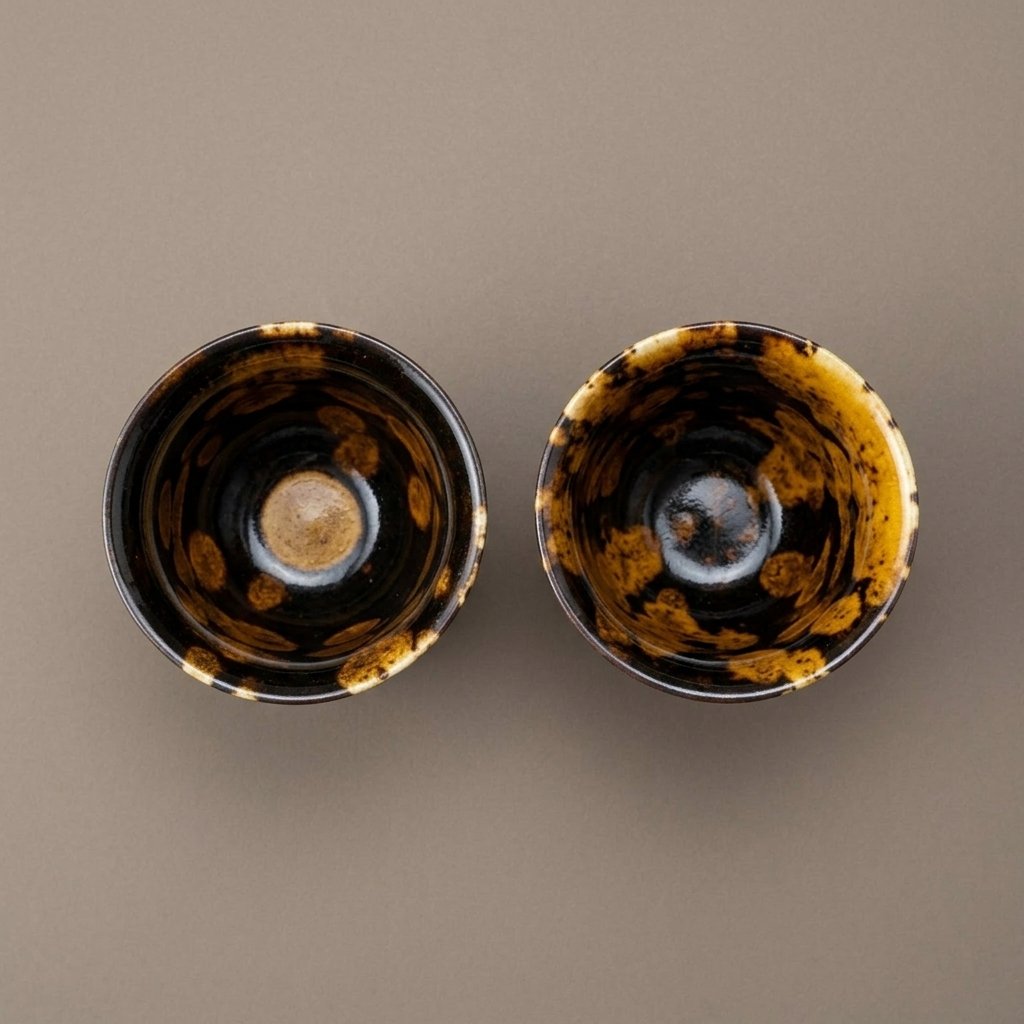
Aurioo’s Leopard Jizhou cup pairs make that arrangement straightforward. Each listing contains two cups. The Leopard tea cup pair has a listed capacity of 60 ml per cup; the Tall Leopard tea cup pair is listed at 50 ml per cup. Choose one style for both samples and keep the pours comfortably below the rims.
Give each tea a fixed place
Set your clean, dry pair on a stable surface with space between the cups. Put two small paper labels beside them, away from wet areas: A on the left, B on the right. Write the corresponding tea names at the top of your notebook. Keep the labels beside the cups rather than attaching them to a hot or wet surface.
The amber and dark glaze markings vary between these handmade cups. Use the written positions to track your samples instead of relying on a particular patch of glaze. After sipping, return each cup to its original place.

Count cups for the tasting you want
One pair serves one taster comparing two teas at the same time. If another person joins, each person needs an A cup and a B cup. Two cups shared between two people would give each person only one sample at a time.
| Tasters | Teas per person | Total cups needed | Two-cup sets needed |
|---|---|---|---|
| 1 | 2: A and B | 2 | 1 pair |
| 2 | 2: A and B | 4 | 2 pairs |
| 3 | 2: A and B | 6 | 3 pairs |
Both Aurioo listings already contain two tea cups per set. For this comparison, use the same pair style throughout. Keep a Tall cup paired with another Tall cup, or use the 60 ml pair for both samples. This keeps the cup choice consistent while your attention stays on the teas.
Prepare two separate brews
ArtfulTea’s tasting guide suggests a flight of teas, preparation according to each packet’s instructions, and written observations. For this two-cup setup, have separate brewing vessels for A and B so you can keep the leaves and finished infusions apart.
Record the leaf amount, water amount, temperature and steeping time for each tea. Use its own directions as the starting point; two different teas may call for different preparation. Mark the infusion round, too, so a first infusion of A is not accidentally compared with a later infusion of B.
When each brew is ready, separate the liquid from its leaves. Arrange the preparation so you can pour the two samples close together. Make modest, comparable pours in the matching cups, leaving headroom in both. Their listed capacities are not fill targets.
Sip, note, then return to the other cup
Let both samples reach a comfortable drinking temperature. Smell A, take a small sip, and write a short observation. Do the same with B, then return to whichever cup you want to check again.
Use words that make sense to you. Notes such as “A reminds me of toasted nuts” or “B feels lighter” are examples of observations you might write, not tasting promises for a particular tea. Leave room for a second thought after another sip.
These cups have dark glazed interiors, so keep this session focused on aroma, taste and your preferences. The apparent darkness of the liquid is not a quality score. A matching handmade pair also does not make the samples a calibrated test; your preparation notes help explain what you tasted.

If you make another infusion, keep A and B in their original positions and start a new line of notes for that round. When you finish, follow the cup listings’ care directions: rinse both cups and dry them before putting them away.
Frequently asked questions
Does one pair give two people a full two-tea comparison?
No. Each person needs two cups to keep A and B available together. For two people comparing two teas, use four cups, or two sets of the same pair style.
Should I fill the cups to their listed 50 ml or 60 ml capacity?
No. Leave headroom and pour a modest, comparable amount into each cup. The figures describe the vessels’ listed capacities, not a required tasting portion.
Can I use one Tall cup and one 60 ml Leopard cup?
For this tea comparison, choose two cups of the same style. Comparing different cup shapes is a separate exercise; keeping the pair together makes this A/B arrangement easier to follow. If you want to compare the cups themselves, try one infusion in a wide and a tall cup.