

Turn an empty porcelain cup over and you may see a small circular support beneath the painted body. That is its foot ring. It is part of the cup’s outside, even though you usually need an underside view to see its full shape.
Aurioo’s Wide and Low porcelain cup listing includes an underside photograph with a clear example. A narrow pale ring surrounds a recessed central area, while the floral decoration continues over the curved body around it.

Find the ring beneath the body
Gotheborg’s glossary of ceramic shapes describes the foot ring as a circular base beneath a vessel. It also separates the body or wall from the foot and names the footrim as the edge of that base.
In the Wide and Low listing’s underside photograph, start at the central pale area and follow the raised circle around it. Then look beyond that circle toward the broad painted curve. You are moving from the underside base, past the supporting ring, onto the cup’s body.
Set the empty cup upright again and look at it from the side. Much of that underside disappears from view. The small foot gives the curved body a distinct ending above the surface where the cup rests. A side photograph and an underside photograph answer different questions.

Separate the inside bottom from the underside
A circular feature photographed through the cup’s mouth is not the foot ring. It belongs to the interior view.
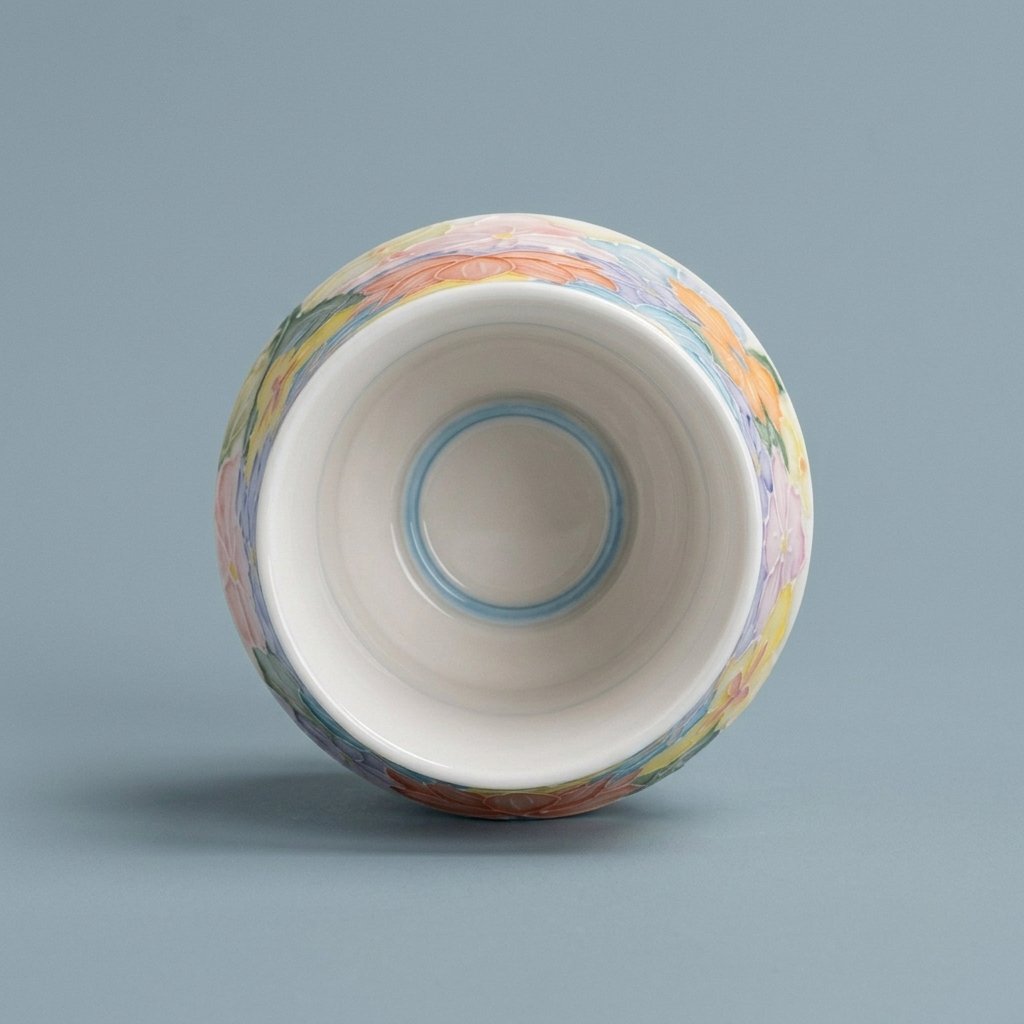
The Fragrance and Flared porcelain cup listing makes that distinction useful. One photograph looks into a cup with a blue circle near the inside bottom. You are seeing the surface that faces the tea. Compare it with the outside base in the Wide and Low listing’s underside photograph.
Check which way the cup is facing before interpreting a detail. Look for the open mouth, painted exterior and supporting foot to orient the view.
| Part to identify | Where to look | What the view tells you |
|---|---|---|
| Cup body | Around the curved exterior | How the painted surface leads toward the base |
| Foot ring | Under the cup, around its central base | The circular support beneath the body |
| Interior bottom | Through the open mouth | The inside surface facing the tea, rather than the exterior foot |
A shape does not identify one making method
The Medieval Pottery Research Group’s guide to ceramic forms defines a footring as a band around or beneath a base. Its definition allows for adding clay or shaping the vessel’s base. The visible form therefore does not establish one particular production method.
For these Aurioo cups, read the stated craft description separately. Both listings describe a hand-painted finish and allow for small differences between pieces. Our explanation of hand-thrown teaware distinguishes forming a vessel from decorating its surface.
An underside photograph also cannot establish a cup’s age or authenticate a maker. Use it to understand the object you are choosing. For a different form, the Ginkgo Douli cup shape guide considers the relationship between a broad rim, sloping body and small foot.
Frequently asked questions
Is the foot ring the whole bottom of the cup?
The term identifies the circular support. The central underside within it and the interior bottom are separate areas to describe.
Does a foot ring prove that a cup was hand-thrown?
No. Read the product’s craft information. A ring-shaped support alone does not establish the method used to make it.
Is the blue circle inside the cup its foot ring?
No. That photograph shows the inside bottom through the open mouth. The foot ring is on the outside, beneath the cup.