
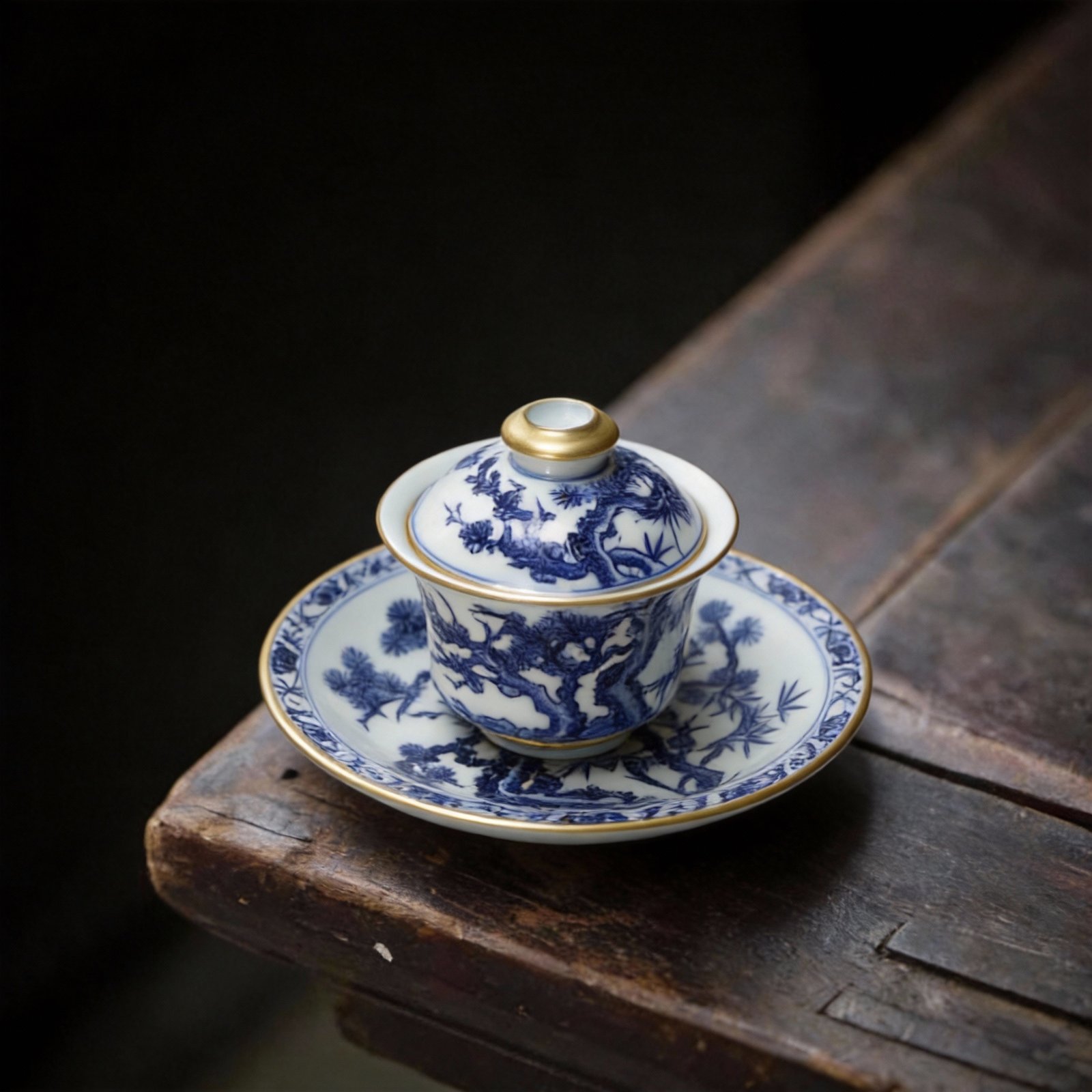
On a painted pine tree, the fine strokes and the heavier branches do different jobs. The branches show the tree’s direction. Short, spreading groups of lines suggest its needle foliage. That distinction helps you read a busy gaiwan lid.
Aurioo’s Pine Tree porcelain gaiwan and gilded Pine porcelain gaiwan both offer close views of this subject. Their lids are useful starting points: you can see several clusters and the branches connecting them in one photograph.
Pine needles are leaves
NC State Extension’s description of Pinus identifies pine leaves as needle-like and explains that they grow in bundles, called fascicles, on short shoots. Bundle characteristics vary among species.
That gives you a useful connection between the living plant and the painted subject. A cluster of narrow strokes can suggest pine foliage without outlining a broad leaf. The painting compresses that structure into marks small enough to fit on porcelain.
A painted cluster should not be read as one precisely recorded fascicle. The artist may gather many needles into a fan-like shape. Counting those strokes will not establish which species the design represents.
Follow a branch into its foliage
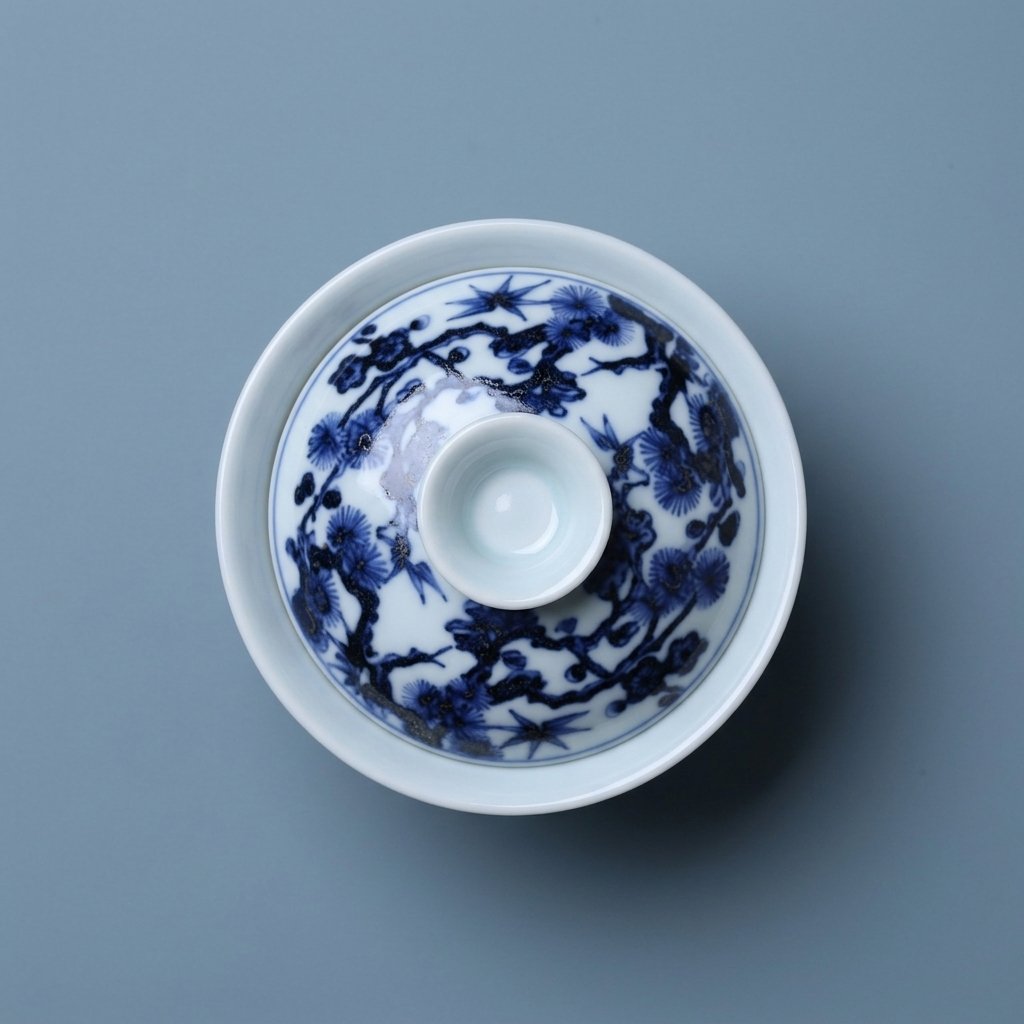
In the overhead photograph of the gilded Pine lid, a dark, bending branch curves around the central knob. Smaller groups of strokes spread outward along it. Follow one section of that branch, then stop where the fine marks gather. This makes the relationship between wood and foliage visible.

Look at a second cluster nearby. Notice its direction and how much room it takes beside the branch. Some groups appear open and fan-like; overlapping marks make others look denser. These are observations about the painted arrangement, rather than measurements of a real tree.
There are other pointed leaf-like forms in the composition, too. Concentrate on the clustered, radiating strokes when looking for the pine foliage instead of treating every narrow blue mark as a pine needle.
| Feature | What to look for in the painting | Limit of the observation |
|---|---|---|
| Needle-like leaf | A narrow stroke within a spreading group | One brushstroke need not equal one real needle |
| Bundle or fascicle | The botanical idea behind grouped needle foliage | A painted fan does not establish a species or a needle count |
| Branch | The heavier, bending structure connecting foliage areas | Its painted shape does not document a particular living tree |

Compare the two gaiwans as objects
After looking closely at the clusters, return to the whole lid and bowl. The Pine Tree version has a white lid knob. The gilded Pine version adds a gold-colored knob and edging. Keep your attention on how each tree composition occupies the surface, rather than assuming the trim changes the botanical subject.
Both gaiwans are listed at 150 mL, 10 cm in diameter and 8 cm high. Choose the order option separately from the decoration. The Pine Tree Gaiwan option is the bowl and lid; the gilded Pine listing also offers combinations with a saucer. Our guide to gaiwan order options explains those labels.
For the cultural context of pine alongside other plants, the Three Friends of Winter guide considers pine, bamboo and plum together. The needle clusters give you a detail to recognize in the photographs.
Frequently asked questions
Are pine needles leaves?
Yes. Needle is the name used for their narrow leaf form. Pines bear these leaves in fascicles, or bundles.
Can the painting identify a pine species?
The listings identify a pine design without naming a species. Painted stroke counts and simplified branch shapes are insufficient for botanical identification.
Do all choices include a saucer?
No. Check the selected option. The Pine Tree listing offers Cup, Gaiwan and Cup&Gaiwan; the gilded Pine listing also has Gaiwan&Saucer and Cup&Gaiwan&Saucer choices.