

A gaiwan can appear in two different tea arrangements. Someone may drink from the covered bowl itself, keeping the leaves inside. In a gongfu setup, the bowl holds the leaves during brewing, then the infusion is poured into a separate drinking cup.
For Aurioo’s White Rim Er Kang gaiwan, the product instructions describe the second arrangement: brew in the bowl and tilt the lid to hold back the leaves while pouring. Decide where you want to drink the finished tea before choosing the other pieces for your table.
When the bowl is also the drinking vessel
Shang Tea’s gaiwan explanation describes direct drinking as one traditional use. The drinker uses the lid to move leaves aside while drinking from the bowl. The leaves remain with the liquid rather than being removed in an infuser basket.
That is a different role from a teapot that stays on the table while you raise a smaller cup.

When the gaiwan works as the brewer
In a decanting arrangement, the tea leaves stay in the gaiwan and the poured liquid goes elsewhere. Liz Clayton’s gaiwan brewing article at Serious Eats describes pouring through a small gap beside the lid and also acknowledges direct drinking as an alternative.
The lid has a related job in both arrangements: it helps keep leaves back at the opening. What changes is the destination of the liquid. For decanting, your drinking vessel is a separate cup. A pitcher can collect the infusion before you divide it among several cups; our fairness pitcher guide explains that serving piece.
| Arrangement | Where you drink | Where the leaves remain | What the lid does |
|---|---|---|---|
| Direct drinking | From the covered bowl itself | In that bowl with the remaining tea | Moves or screens leaves near the drinking opening |
| Brewing and decanting | From a separate tea cup | In the brewing bowl after the liquid is poured out | Forms an opening for pouring while holding leaves back |
Pouring the infusion out separates that serving from the leaves. It also lets you put the brewing bowl down before lifting the drinking cup. Those are practical reasons to keep the two roles separate when arranging your tea session.
Read the instructions for the actual piece
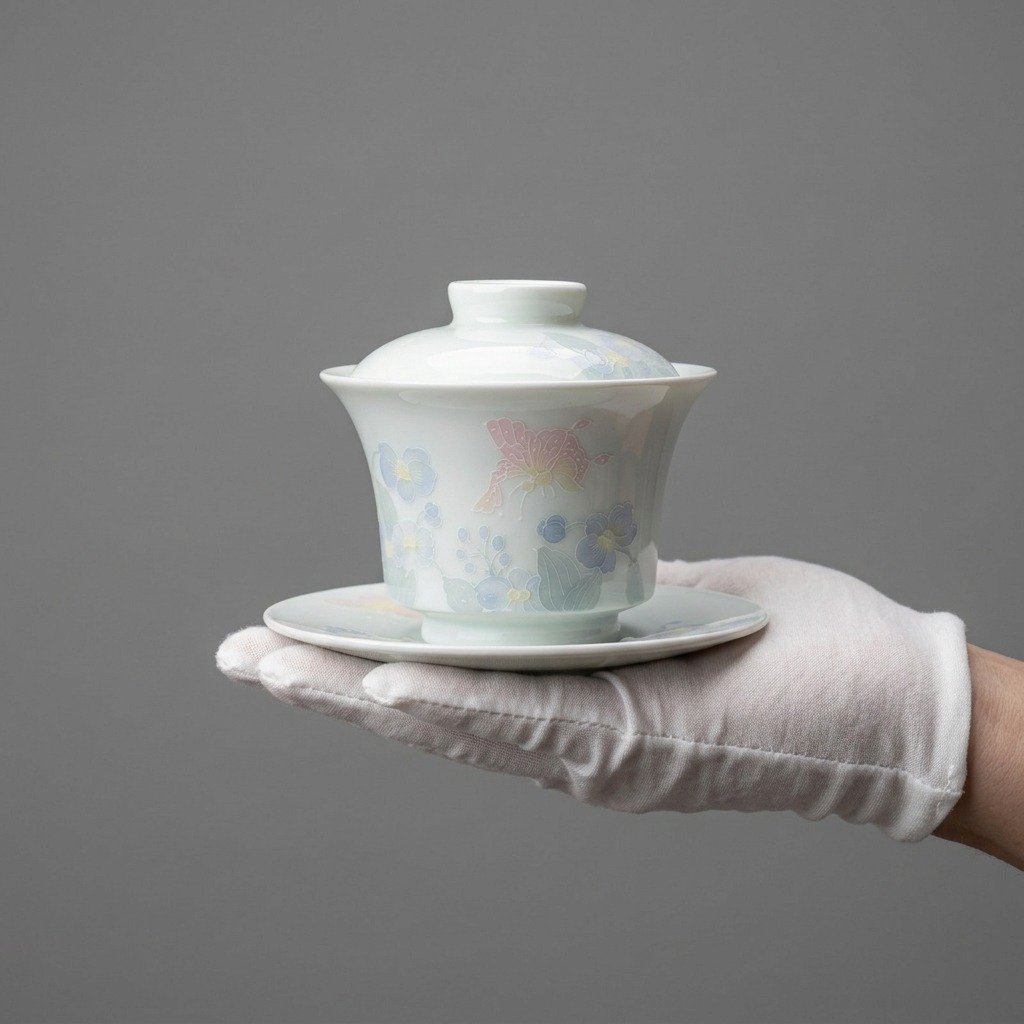
The White Rim Er Kang listing describes high-white clay ceramic, a bowl approximately 8 cm across and 6 cm high, and a listed capacity of about 150 mL. Its matching saucer is 10 cm across. The care instructions ask you to dry the bowl, lid and saucer separately after use.
Aurioo’s Butterfly Floral Relief gaiwan is another brewing example. It has a listed capacity of 180 mL, measures 8.5 cm across and 7.5 cm high, and has an 11 cm saucer. Its instructions likewise describe controlling the pour with the lid.
Both listings supply a gaiwan and saucer, rather than a separate drinking-cup collection. Check your selected quantity and included pieces. Our gaiwan and saucer options guide explains why the order description matters.

Choose the arrangement before practising
For the two Aurioo models above, start with their documented brewing-and-pouring use. Arrange a receiving vessel within reach and practise the movement with cool water on a stable surface. Follow the particular tea’s preparation directions when you move on to brewing.
If you want to drink directly from a covered bowl, confirm that intended use and a comfortable way to hold your particular piece. For a fuller introduction to the decanting arrangement, follow our first gongfu tea session guide.
Frequently asked questions
Can tea be drunk straight from a gaiwan?
Yes, direct drinking is an established use of the covered bowl. For an individual product, check its instructions and suitability rather than assuming every gaiwan is equally comfortable to sip from.
Does a gaiwan set always include drinking cups?
No. The two listings discussed here contain a gaiwan and matching saucer. Separate drinking cups are additional pieces for a decanting setup.
Does a saucer guarantee a comfortable grip?
No. Check the actual bowl, lid and saucer together and practise the documented movement with cool water. Use the product’s own instructions for handling and care.